Olive oil originated in the Fertile Crescent around 5,000 BC and was introduced to the Iberian Peninsula, through Andalusia, by the Phoenicians in the 11th century BC.
KEY FACT
The production method has evolved tremendously over these 7,000 years, but fundamentally follows the same principle of extracting the fruit juice that is virgin olive oil, a natural olive juice.
Just as the quality of orange juice depends primarily on the freshness and health of the orange from which it is made, in olive juice—virgin olive oil—its quality will depend enormously on the olive from which it is produced, the date and method of harvesting, its transport to the mill, the speed with which it is pressed, the cleanliness, type, and characteristics of the mill machinery, operating parameters such as temperature and malaxation times, and finally the storage of the oil obtained in the cellar. Let us examine each part.
Olive variety: how it influences the quality of olive oil
In another article we have discussed olive varieties and their general characteristics in more detail, but for production purposes, it is very important to consider the variety because although the cleaning and milling processes may be similar, certain processes such as malaxation, centrifugation, and storage may require different production parameters. Sweet varieties low in natural antioxidants may need shorter malaxation times and lower centrifugation speeds than more bitter varieties high in polyphenols.
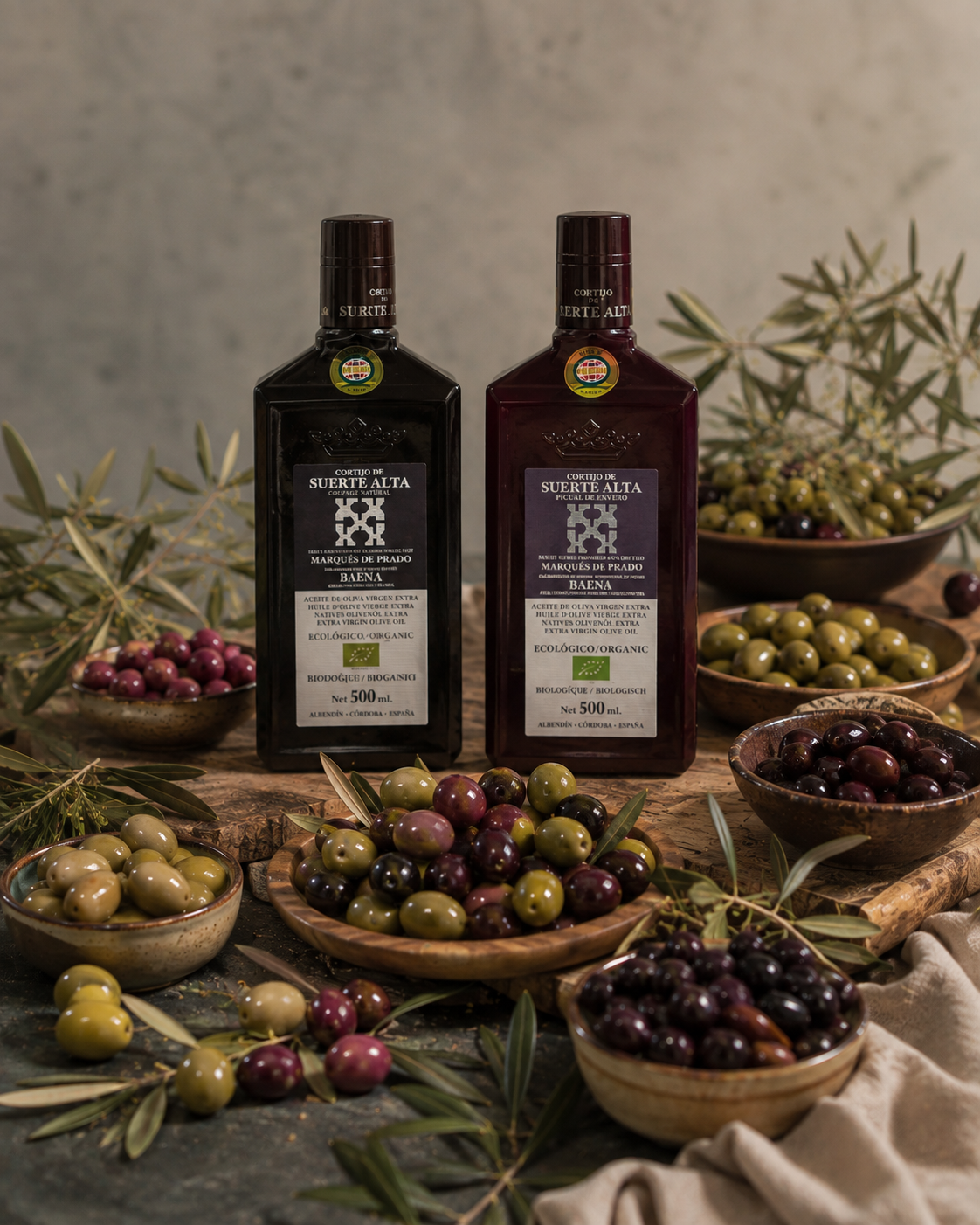
Cortijo de Suerte Alta Coupage is obtained from a traditional olive grove with intermingled Picudos, Hojiblancos, Picuales, and Pajareros, which produces a very balanced and complex oil.
Cortijo de Suerte Alta Picual is obtained from Picual olive trees, both traditional and young, which produce a very stable oil high in antioxidants.
Marqués de Prado is obtained from Arbequina hedgerow olives grown without irrigation on our Seville estate with 15% Picual from Suerte Alta, resulting in a fruity and sweet oil with a good level of polyphenols that manifests in its moderate pungency.
Rainfed or irrigated olives: differences in oil quality
Regardless of variety, rainfed or irrigated olive groves produce olives with very different profiles. Rainfed olive groves, especially in years with low rainfall, can produce olives excessively high in polyphenols that would yield unbalanced oils due to excessive bitterness or pungency. Conversely, irrigation with high water allocations can produce high olive yields but low in polyphenols and with little sensory intensity. Controlling water inputs at critical moments, with periods of irrigation restriction and water stress at certain points in fruit development, can produce the most balanced fruit from both a sensory and physicochemical perspective of the oil produced.
When to harvest olives? The importance of the harvest period
When olives are fully ripe, their skin is black as is the interior pulp. At this point, usually in January, the percentage of oil content is at its maximum but it has lost much of its analytical and sensory values. Defects may appear in taste and aroma, acidity and oxidation parameters may be elevated, and natural antioxidants diminished. This late harvest typically yields oils very high in yield and quantity but of low quality, normally virgin or lampante oils usually destined for refining to produce refined olive oil.
To obtain EVOO it is necessary to start with early-harvest olives, when the skin and interior pulp are green or purple, normally in October and November. This moment when part of the milled olive is between green and purple is called “veraison,” that is, when the olive is truly at its optimal point. At this early harvest moment, the yield—percentage of oil contained in the olive—is lower than when it is black and fully ripe, but its quality is at its maximum.
Cortijo de Suerte Alta Coupage Natural oil is harvested in the second half of October and Cortijo de Suerte Alta Picual and Marqués de Prado in November.
Olives from the tree or from the ground: why it makes a difference in EVOO
To obtain EVOO it is essential that the olive be picked directly from the tree, scrupulously separating tree olives from those previously fallen to the ground. A small proportion of ground olives mixed with those from the tree will result in detectable sensory defects in the oil.
At Cortijo de Suerte Alta, early harvesting allows us to obtain practically all the fruit from the tree to produce very high quality EVOO. We only harvest an average of 8% of olives from the ground annually.
At the end of the season and in areas where some olives may have fallen, ground olives are collected and from these olives a lower quality virgin olive oil is obtained but suitable for organic cosmetics.
Transport of olives to the mill: speed and care
Olives must be transported to the mill as quickly as possible, avoiding crushing and piling as harmful fermentations would begin that are detrimental to oil quality, so harvested olives must be milled on the same day.
At Suerte Alta, olives are milled immediately and always within six hours of harvesting.
Cleaning the olives before entering the mill
Before entering the mill, leaves, soil, and dust that could affect oil quality must be removed. When olives are picked directly from the tree, they come clean of mud and soil, so blowing to remove leaves is usually sufficient along with a shower to remove summer dust from the olive skin.
Milling the olives: from stone mill to hammer mill
In antiquity it was always done mechanically in small manual stone mills that subsequently increased in size while transitioning to animal, hydraulic, steam, and electric power. Stone mills crushed the olive very well but had the drawback of low productivity, they aerated and rapidly oxidized the paste, and were difficult to clean.
Currently olives are usually milled, also mechanically, with hammer mills and perforated screens or slats, which have the advantage of greater productivity and being closed and made of stainless steel, easy to clean. The paste does not oxidize as it is then transported in closed stainless steel pipes to the malaxer.
Malaxation of the paste: temperature and time for quality EVOO
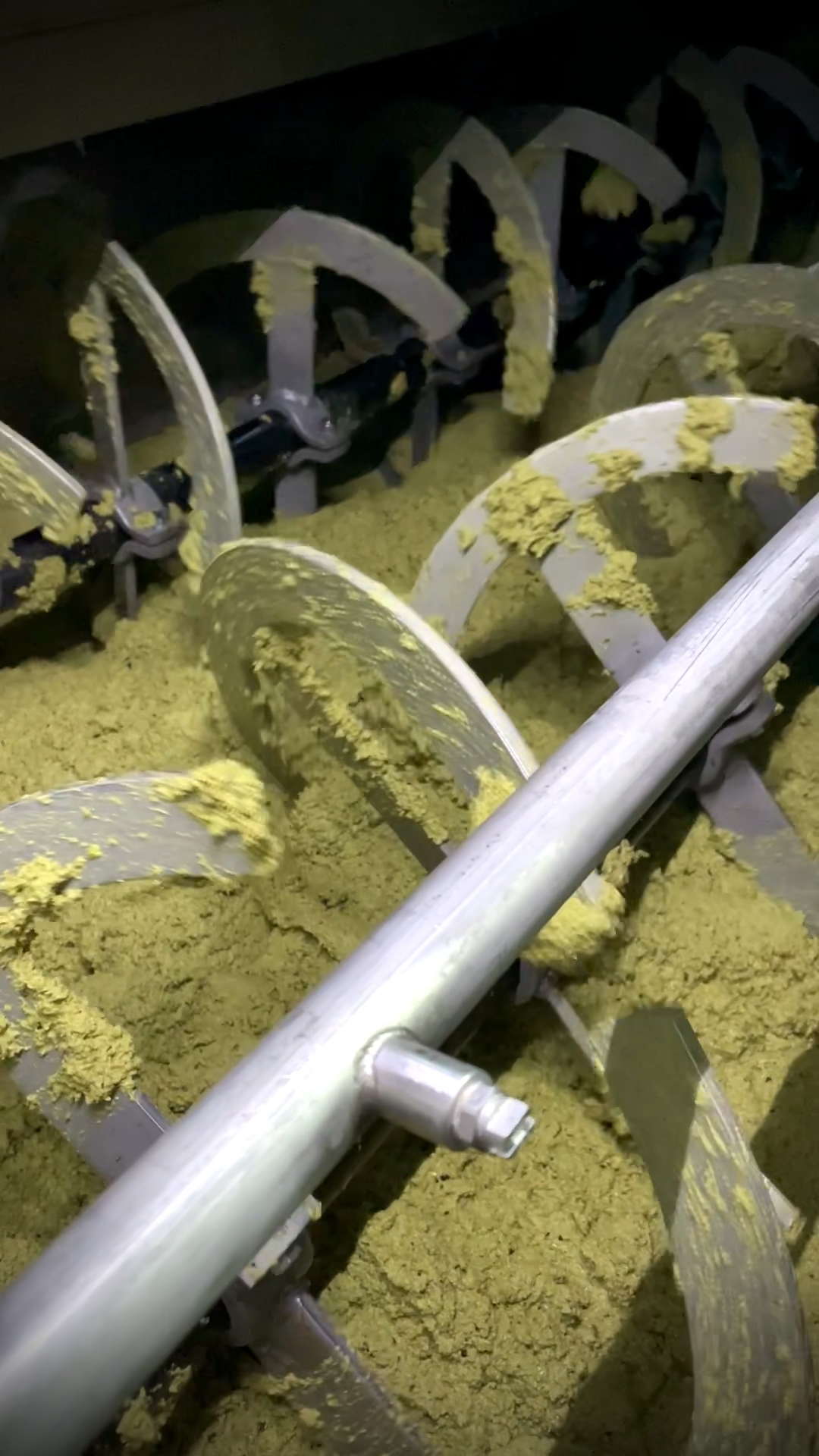
This is a fundamental and decisive phase in the quality of the oil obtained. The freshly crushed paste from the mill is not homogeneous and is usually at an inadequate temperature for subsequent extraction. The oil in the olive is found in small cells isolated from each other, separated from the vegetable water. When crushing the olive, these cells break and the small micro-droplets of oil join with others to form droplets of greater volume and weight and more easily extractable in subsequent centrifugation. Furthermore, the paste temperature to obtain quality oils must be below 27°C, with 24°C being an appropriate temperature. Malaxation serves to bring the paste to that temperature, heating or cooling the paste depending on the season. The longer the malaxation time, the greater the grouping of oil droplets in the paste, and in high-yield pastes oil pockets can be observed floating in the paste after long malaxation, which will greatly facilitate its extraction.
The problem is that with longer malaxation time and higher temperature, losses of oil aroma, oxidation, and undesirable fermentations also increase. Conversely, with short malaxation times and low temperatures, 24°C, aromas are maintained and fermentations are avoided. Furthermore, during malaxation the oil comes into contact with the vegetable water from the olive itself and, since polyphenols are water-soluble, the oil loses a good part of its natural antioxidants which remain dissolved in the water.
In summary, quality EVOOs are obtained with short malaxation at low temperature, while when milling with quantity rather than quality in mind, temperatures and malaxation times are significantly higher.
At Cortijo de Suerte Alta, malaxation times are between 30 and 45 minutes, depending on the variety, and the average working temperature is 24°C.
Centrifugation or pressing: how olive oil is extracted
Extraction, always mechanical, aims to separate the three phases present in the olive paste: oil, vegetable water, and the solid part formed by the pulp and crushed olive pit.
Pressing was the method our grandparents used. In our family, olives were milled in an old stone mill and press located in one of the estate’s farmhouses. The paste or olive mass was deposited between esparto mats, circular esparto fiber mats, which were threaded onto a shaft, forming stacks a couple of meters high that were subsequently pressed. The liquid part, oil and water mixed together, slid down the outside of the mats and was collected at the base of the column and channeled to pools for subsequent separation by decantation.
Pressing, apart from being a slow and laborious process, was very dirty because the esparto mats were practically impossible to clean as the paste deposited between the esparto fibers and degraded and became rancid there, giving undesirable aromas to all the oil produced in subsequent days.
Currently, extraction is not done by pressing but by centrifugation, in closed horizontal centrifugation equipment with stainless steel interiors called “decanters” where the oil is centrifuged and separated from the water and vegetable mass. At Suerte Alta we have a decanter that allows us to regulate different rotation speeds and other centrifugation factors, depending on the variety, type, and moisture of the paste.
Cleaning the oil: vertical centrifugation and decantation
The oil from the horizontal centrifuge or “decanter” is never completely clean, with some moisture and vegetable mass that must be eliminated as soon as possible as it can deteriorate the oil itself. In most modern mills, this oil cleaning is usually done by centrifuging the oil. If in the horizontal decanter what was centrifuged was the solid mass at about 3,000 rpm, in this phase of the process what is centrifuged is the liquid oil at about 6,000 rpm to completely eliminate residual moisture and impurities in the oil. To facilitate this cleaning and separation, hot water is added to the oil. This process has the advantage of being very fast and the oils are cleaned of vegetable moisture and its sugars and impurities. Conversely, polyphenols, being water-soluble, are partly lost in the added water, decreasing their content in the oil.
The other oil cleaning system from horizontal centrifugation is static decantation in small settling tanks. This is the method used at Suerte Alta. The oil is kept for one day in these tanks, gradually purging through the lower zone of the tank, since water and suspended solids, being heavier than oil, settle at its conical bottom. This method is slower and requires daily cleaning of the tanks used, but conversely the oil obtained retains all its polyphenols as it has not been washed with water. Cortijo de Suerte Alta EVOOs can have total contents greater than 1,000 mg/kg of total polyphenols.
Filtering olive oil: why it is essential for its preservation
This process is essential to completely eliminate moisture and solid residues in the oil. Unfiltered oils, over time, deposit a kind of sediment at the bottom of the container composed of water and suspended solids where undesirable fermentations occur that destroy the quality of the bottled oil, producing organoleptic defects, bad flavors and odors, having a very short best-before date. In the filtering process, diatomaceous earth or cellulose is used, inert and authorized in organic agriculture.
Storage in the cellar: how EVOO is kept to maintain its quality
EVOOs must be stored in the cellar in sealed stainless steel tanks at stable temperatures between 15°C and 25°C. Oils with a low level of polyphenols, being less stable, may require inerting with nitrogen to prevent oxidation or rancidity. Suerte Alta EVOOs, due to their polyphenol level, do not require inerting, but are kept with the minimum possible air in the tanks to prevent oxidation.
All EVOOs produced at Suerte Alta are 100% family-produced and organic. To minimize the content of phthalates, plastic plasticizers, in the oils obtained, all plastic parts, pipes, or connections have been eliminated from the mill machinery. Olive conveyor belts are likewise made of rubber or food-grade PVC free of phthalates.
Frequently asked questions about how olive oil is made
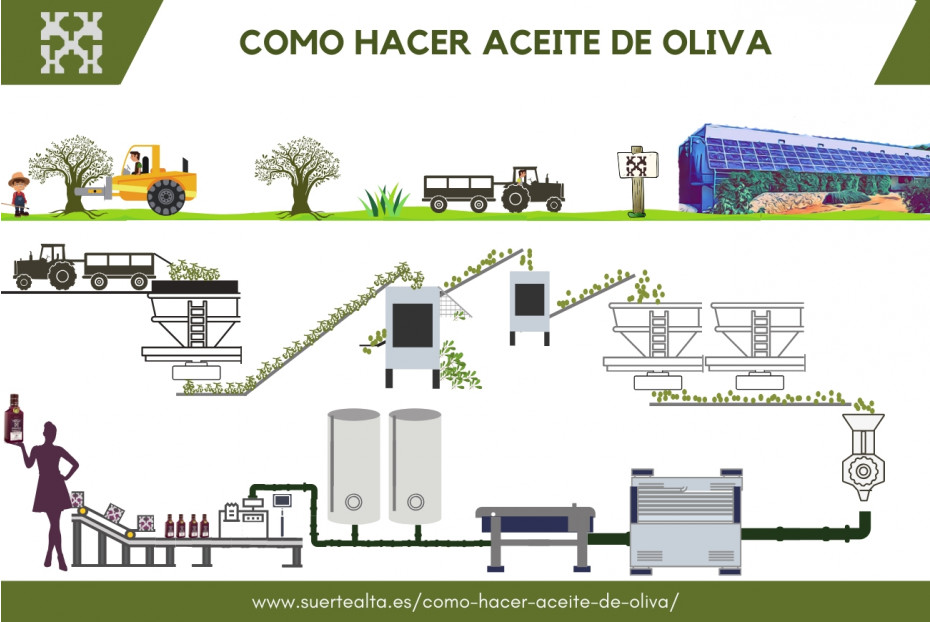
The olive oil production process comprises the following phases: selection of variety and type of cultivation, period and method of harvesting, urgent transport to the mill, cleaning, milling, low-temperature malaxation, centrifugation or pressing, oil cleaning by decantation or vertical centrifugation, filtering, and storage in the cellar.
To obtain quality extra virgin olive oil, the paste must be malaxed at a maximum temperature of 27°C, with 24°C being the optimal temperature. At higher temperature and longer malaxation time, the oil loses aromas and natural antioxidants.
Olives fallen to the ground, even in small proportion, introduce detectable sensory defects in the final oil. To produce high quality EVOO it is essential to scrupulously separate tree olives from ground olives before milling.
Unfiltered oil contains moisture and suspended solids that, over time, ferment at the bottom of the container and deteriorate the oil quality, shortening its shelf life. Filtering with diatomaceous earth or cellulose eliminates these residues and guarantees greater stability and product longevity.