When consumers go to buy olive oil, they may find these categories on the shelf: Extra Virgin Olive Oil (EVOO), Virgin Olive Oil (VOO) and Olive Oil (OO). The big confusion, sometimes deliberate, is not knowing whether “olive oil” refers to the whole group or to a specific commercial category.
KEY FACT
Suerte Alta EVOOs do not exceed an acidity of 0.2°, well below the official maximum of 0.8% required to be called extra virgin.
An olive mill only produces virgin olive oils (extra virgin, virgin or lampante), all obtained exclusively by mechanical means.
The categories, one by one
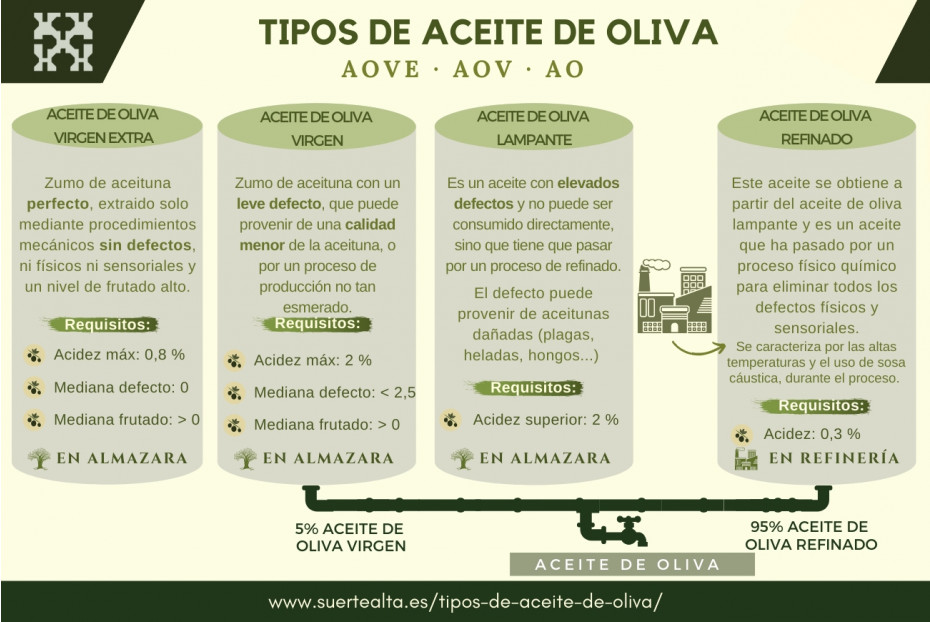
Extra Virgin Olive Oil: a perfect olive juice, free of defects, with an official maximum acidity of 0.8% (Suerte Alta’s do not exceed 0.2°, with a fruitiness above 4). It retains vitamins and polyphenols, with no additives or preservatives. It is certified through the Panel Test, carried out by at least 8 tasters in standardised blind tastings.
Virgin Olive Oil: an olive juice with a slight sensory defect, acidity of up to 2%, and fewer antioxidants and vitamins than extra virgin.
Lampante Virgin Olive Oil: with significant defects (damaged olives, late harvesting or olives collected from the ground, poor processing), unfit for direct consumption: it must be refined.
Refined Olive Oil: lampante oil subjected to a physical-chemical process (high temperatures, caustic soda, phosphoric acid, clays) that removes defects, but also the natural polyphenols and antioxidants. It cannot be bottled on its own.
“Olive Oil, contains…”: a blend of ~90% refined oil and 5-10% virgin or extra virgin oil, with no flavor or aroma of its own. 70% of Spanish consumers still cannot tell this category apart from EVOO.
Frequently asked questions about types of olive oil
EVOO is 100% pure olive juice; “olive oil” is a blend of ~90% refined oil with some virgin oil.
A virgin oil with significant defects, unfit for direct consumption, which must go through refining.
0.8% officially. Suerte Alta’s do not exceed 0.2°.
Virgin oil has at most a slight sensory defect; lampante oil has significant defects and is unfit for direct consumption, so it must be refined first.