Olive oil originated in the Fertile Crescent around 5,000 BC and was introduced to the Iberian Peninsula, through Andalusia, by the Phoenicians in the 11th century BC.
KEY FACT
The production process has evolved enormously over these 7,000 years, but it still follows essentially the same principle: extracting the fruit juice that virgin olive oil is, a natural olive juice.
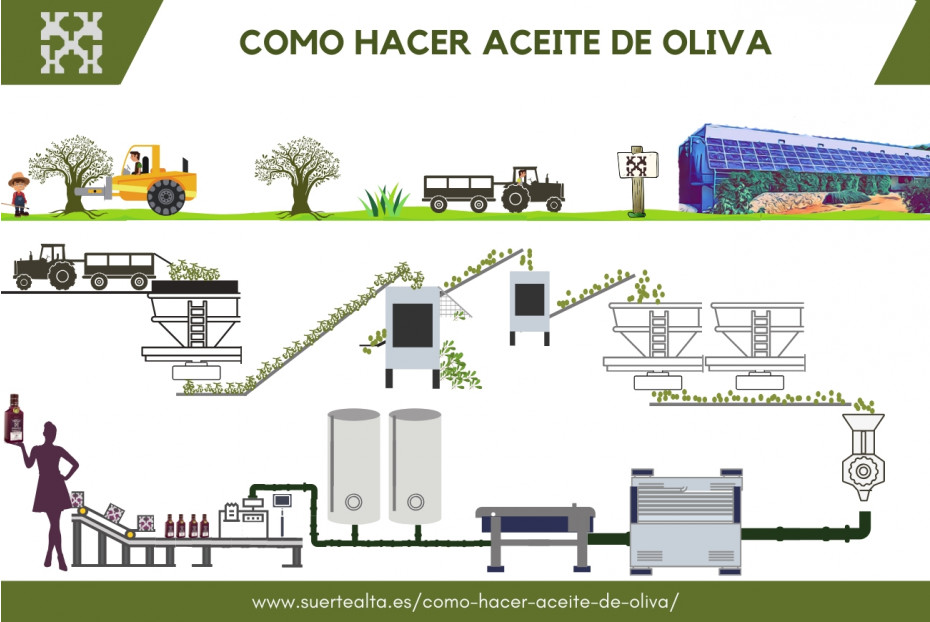
Just as the quality of orange juice depends mainly on the freshness and health of the oranges it is made from, the quality of olive juice, that is, virgin olive oil, depends enormously on the olives it is made from, the date and method of harvesting, their transport to the mill, how quickly they are milled, the cleanliness, type and characteristics of the mill machinery, operating parameters such as malaxation temperature and time and, finally, how the oil is stored in the cellar. Let’s look at it step by step.
Olive variety: how it affects olive oil quality
It is important to take the variety into account because, although the washing and milling processes may be similar, others such as malaxation, centrifugation and storage require different parameters. Sweet varieties that are low in antioxidants need shorter malaxation times and lower centrifugation speeds than more bitter varieties that are high in polyphenols.
- Coupage: from a traditional olive grove with Picudo, Hojiblanca, Picual and Pajarero trees growing side by side, a very balanced and complex oil.
- Picual: from Picual olive trees, both traditional and young: very stable and high in antioxidants.
- Marqués de Prado: from Arbequina trees in a rain-fed hedgerow grove (estate in Seville) with 15% Picual: fruity and sweet, with a good level of polyphenols reflected in its moderate pungency.
Rain-fed or irrigated olives: differences in oil quality
Rain-fed olive groves, especially in years with little rainfall, can yield olives that are excessively high in polyphenols, with too much bitterness or pungency. Heavily irrigated groves produce a larger quantity but fewer polyphenols and less intensity. Controlled irrigation, with restrictions at critical moments, produces the most balanced fruit.
When should olives be harvested? The importance of the harvest period
When the olives are fully ripe (black skin and flesh, usually in January), oil yield is at its highest but sensory quality is low. These oils are usually sent to refineries. Extra virgin olive oil (EVOO) requires an early harvest (October-November), when the olives are “at veraison” (between green and purple): the yield is lower, but the quality is at its peak.
Coupage Natural is harvested in the second half of October; Picual and Marqués de Prado, in November.
Olives from the tree or from the ground: why it makes a difference in EVOO
EVOO requires olives picked directly from the tree. Even a small proportion of olives from the ground mixed in produces detectable sensory defects. At Suerte Alta, only 8% of the olives, on an annual average, come from the ground, and they are used to make a lower-quality virgin oil suitable for organic cosmetics.
Transporting the olives to the mill: speed and care
The olives must reach the mill and be milled on the same day, avoiding crushing and stockpiling (which would trigger harmful fermentation). At Suerte Alta, this always happens within six hours of harvesting.
Cleaning the olives before milling
Leaves, soil and dust must be removed. Since the olives are picked directly from the tree, they usually arrive free of mud, so a blast of air for the leaves and a rinse for the summer dust are enough.
Milling the olives: from stone mills to hammer mills
In the past, manual stone mills were used: they broke down the olives well, but with low productivity, rapid oxidation and difficult cleaning. Today, hammer mills with screens are used: they are more productive, enclosed, made of stainless steel and easy to clean, and the paste is then carried through closed pipes that prevent oxidation.
Malaxation of the paste: temperature and time for a quality EVOO
A decisive stage: crushing the olives breaks the cells that contain the oil, and malaxation gathers the micro-droplets into larger drops that are easier to extract. The temperature must be kept below 27°C (24°C is optimal). The longer the malaxation time and the higher the temperature, the more aromas and antioxidants are lost (polyphenols are soluble in the vegetation water that the oil comes into contact with). At Suerte Alta, malaxation times range from 30 to 45 minutes, depending on the variety, at an average temperature of 24°C.
Centrifugation or pressing: how olive oil is extracted
Traditional pressing (with esparto grass mats) was slow, laborious and very messy: the mats were almost impossible to clean and made the oil go rancid. Today, extraction is carried out by horizontal centrifugation in a closed stainless steel “decanter”. At Suerte Alta, the decanter makes it possible to adjust the rotation speed according to the variety, type and moisture content of the paste.
Cleaning the oil: vertical centrifugation and decanting
The oil coming out of the horizontal decanter still contains moisture and plant solids. Most mills clean it with a second, vertical centrifugation (at 6,000 rpm, adding hot water): it is fast, but some of the polyphenols are lost. Instead, Suerte Alta uses static decanting in tanks: the oil rests for one day, which is slower and requires daily cleaning, but the oil is never washed with water. Suerte Alta’s EVOOs can exceed 1,000 mg/kg of total polyphenols.
Filtering olive oil: why it is essential for preserving it
If left unfiltered, the oil gradually deposits a “sludge” of water and solids that ferments and degrades its quality, shortening its best-before date. Filtering uses diatomaceous earth or cellulose, which are inert and suitable for organic farming.
Cellar storage: how EVOO is kept to preserve its quality
It is stored in airtight stainless steel tanks at 15-25°C. Oils low in polyphenols may need to be blanketed with nitrogen; Suerte Alta’s oils do not need this thanks to their polyphenol levels, although the tanks are kept with as little air as possible. All the mill’s machinery is free of plastic parts to minimize phthalates, and the conveyor belts are made of rubber or food-grade PVC free of them.
Lorem ipsum dolor sit amet consectetur
Choosing the variety and growing method, the harvest period and method, fast transport to the mill, cleaning, milling, low-temperature malaxation, centrifugation or pressing, cleaning the oil, filtering and cellar storage.
A maximum of 27°C, with 24°C being the optimal temperature.
Because even a small proportion of olives from the ground introduces detectable sensory defects into the final oil.
Unfiltered oil contains moisture and solids that ferment over time and shorten its shelf life; filtered oil, processed with diatomaceous earth or cellulose, is more stable and longer-lasting.