
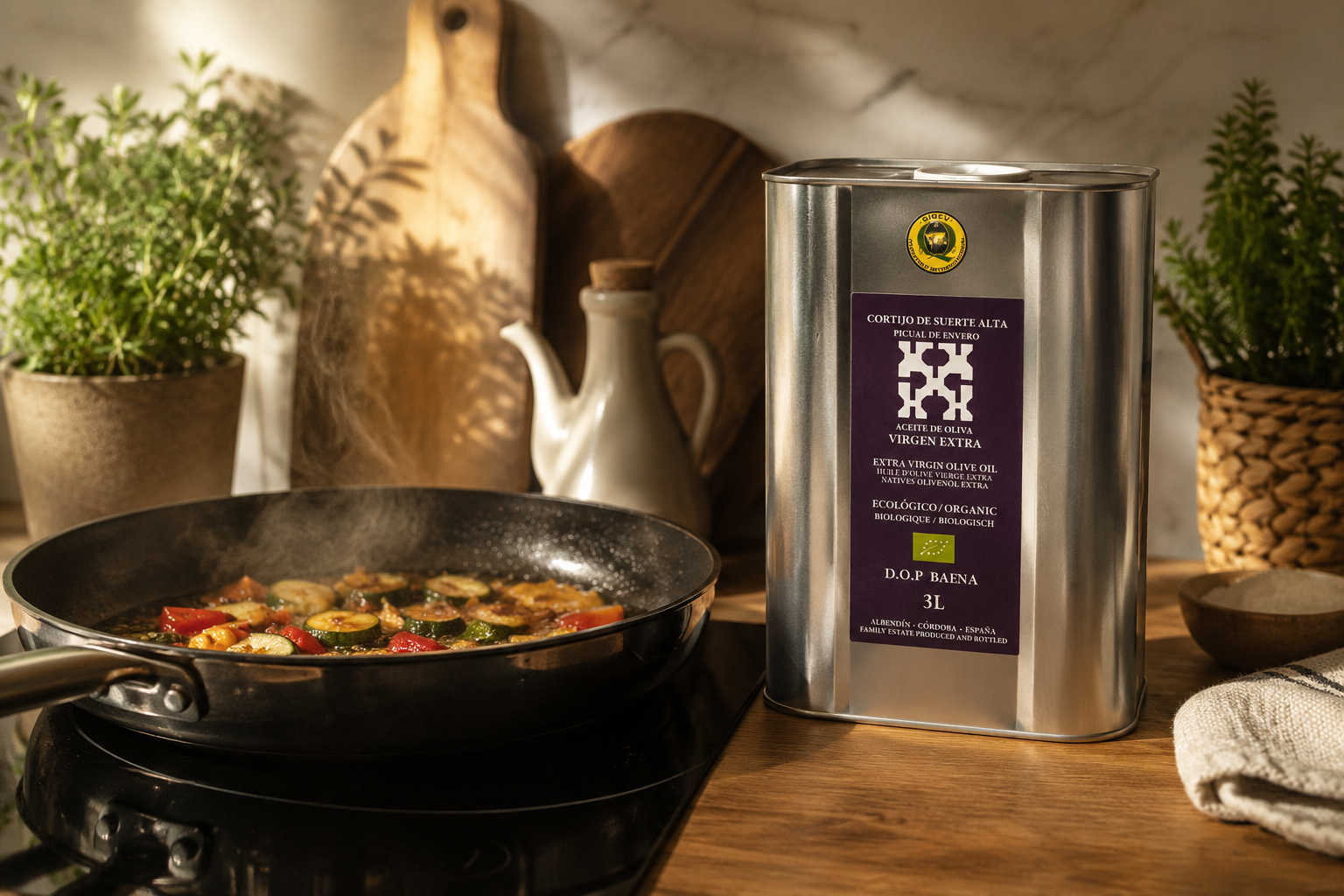
Better flavor, less fat and more stability: this is what changes when you fry with EVOO.
Frying with Extra Virgin Olive Oil is one of the healthiest and tastiest ways to cook. Thanks to its high heat stability and its wealth of natural antioxidants, EVOO protects food better during frying, delivers a crispier finish and helps preserve its flavor. Discover why it is the best choice for frying and how to make the most of all its properties.
KEY FACT
Olive oil is 50 times less prone to oxidation than seed oils.
Why Virgin Olive Oil withstands heat better than other vegetable oils
Antonia Chiou and Nick Kalogeropoulus show in their study “Olive Oil as a Frying Oil” that Virgin Olive Oil performs better than other vegetable oils when frying, as it shows greater heat resistance. This is mainly due to its fatty acid profile and the presence of a variety of natural antioxidants, which protect it against thermal stress, making olive oil the preferred choice for frying. Olive oil contains between 55% and 83% monounsaturated oleic acid, making it 50 times less prone to oxidation than linoleic acid (Chiou and others, 2017), the polyunsaturated fatty acid that predominates in most vegetable oils. Under normal cooking conditions, with temperatures between 180 and 190 degrees, as is usual when frying, olive oil performs better than other vegetable oils. Moreover, virgin olive oil performs even better than vegetable oils high in oleic acid, such as high-oleic sunflower oil, thanks to the antioxidants present in virgin olive oil.
Frying with olive oil also improves the quality of the fats consumed. Adding olive oil to food when frying results in a favorable fatty acid profile, high in monounsaturated fats and low in saturated fats. Furthermore, when virgin and extra virgin olive oil are used for frying, they transfer their micronutrients to the food: polyphenols, tocopherols, squalene, terpenic diols and natural sterols.
Which EVOO to choose for frying
Antonia Chiu and Nick Kalogeropoulus tell us that EVOOs produced from green olives that have not yet reached full ripeness perform better when used for frying. We have confirmed this at Cortijo de Suerte Alta. Early harvest oils are much higher in polyphenols and micronutrients. These micronutrients give EVOOs greater stability, which is why early harvest oils are better for frying. On top of that, some varieties are higher in polyphenols and micronutrients than others, such as Picual compared to Arbequina. This makes Picual a better oil for frying than Arbequina, since it is more stable.
EVOO smoke point: what it really means and why it matters
Seed oils and refined oils have a higher smoke point than olive oil. The smoke point is the temperature at which the oil starts to smoke. Some people think seed and refined oils are better for frying because they have a higher smoke point, taking this figure as a sign that these oils do not break down at higher temperatures. What this figure really means is that food has to be heated to a higher temperature to fry with these oils. A lower smoke point, as in the case of virgin olive oil, does not mean the oil fries less, but that it fries at a lower temperature. With a refined sunflower oil that has a smoke point of 230°, you have to bring the oil to 230° for it to fry. With extra virgin olive oil, which has a smoke point of 160°, you need to heat the oil less. When the oil is heated less, it breaks down less. You also heat the food less, so it breaks down less too. It is important to stress that the oil with a smoke point of 160° is extra virgin olive oil, not refined sunflower oil or olive oil, both of which have a smoke point of 230°.
Another problem with a high smoke point is that you have to heat the food more, and as a result, if you fry meat in a seed oil, the fat from the meat melts into it. When you use that oil to fry a second time, it is no longer just seed oil but a mixture of seed fat and saturated animal fat. With olive oil, since it fries at a lower temperature, the animal fat does not melt, and when you use the oil a second time, you are frying only with vegetable fat. If you fry fish in sunflower oil, the fish fat stays in the oil.
Using olive oil for frying also has an economic advantage. First, because the fryer does not need to be heated as much, which saves energy. Second, because less olive oil is needed for frying. When frying with EVOO in a deep fryer, it is important to set the temperature to 180°.
Why the oil you fry with matters more than you think
In his article “Frying food in olive oil,” Gregorio Varela explains that in Spain, and in Mediterranean countries in general, approximately 50% of total fat intake comes from cooking fat. But the most interesting point is that only a small fraction of this cooking fat is consumed raw, as a dressing for food, while most of it is used for deep frying. Hence the vital importance of the oil we use for frying, since choosing the oil we fry with allows us to control our fat intake.
Frying, yes, but properly: what happens inside the food when the technique is right
Gregorio Varela, Professor of Nutrition at the Complutense University of Madrid, explains in his article “Frying food in olive oil” that when the frying process (also known as deep frying) is carried out correctly, it is less damaging to the nutritional value of food than other cooking techniques and also helps improve fat intake. This is because the food does not exceed 100° for two-thirds of the frying time, regardless of the temperature of the oil used. The reason is that the water in the food must evaporate before the oil can penetrate it. This is very important because it means the oil has little impact on the food. According to Varela, deep frying (DF) has a series of benefits:
1) The hot oil acts on the food for an extremely short time.
2) Deep frying is less damaging to the nutritional value of fried food than other cooking processes.
3) The amount of fat ingested, and therefore its calorie content, is also lower than with other processes.
Less fat, more flavor: how EVOO seals food without soaking it
When frying, EVOO “seals” the food sooner and at a very low temperature, so it does not penetrate the inside and prevents what we are frying from getting soaked in fat. Seed oil does not form a crust and therefore penetrates further into the croquette. EVOO forms a crust, which means less oil gets into the croquette. So we will get less oily croquettes if we fry with EVOO.
References
Varela, G. (1994) “Frying food in olive oil”. International Olive Council. Madrid.
Antonia Chiou, Nick Kalogeropoulos. (2017) “Virgin Olive Oil as Frying Oil”. Comprehensive Reviews in Food Science and Food Safety.16 (4) , 632-646. https://doi.org/10.1111/1541-4337.12268
Frequently asked questions about frying with Olive Oil.
Yes. Scientific studies show that EVOO is the most stable oil for frying thanks to its high oleic acid content (55-83%) and its natural antioxidants, which protect it from heat better than any other vegetable oil.
Because oleic acid, which predominates in olive oil, is 50 times less prone to oxidation than linoleic acid, the main fatty acid in seed oils such as sunflower oil.
Quite the opposite. EVOO seals the food at a low temperature, creating a crust that prevents the oil from penetrating the inside, resulting in less oily food.
Yes, if done correctly. Deep frying is less damaging to the nutritional value of food than other cooking techniques, since the food does not exceed 100°C for two-thirds of the process.