At a temperature of 16 °C, the average density of olive oil is 0.916 kg/litre. As the temperature rises, the density decreases because the oil expands: the higher the temperature, the less the oil weighs.
KEY FACT
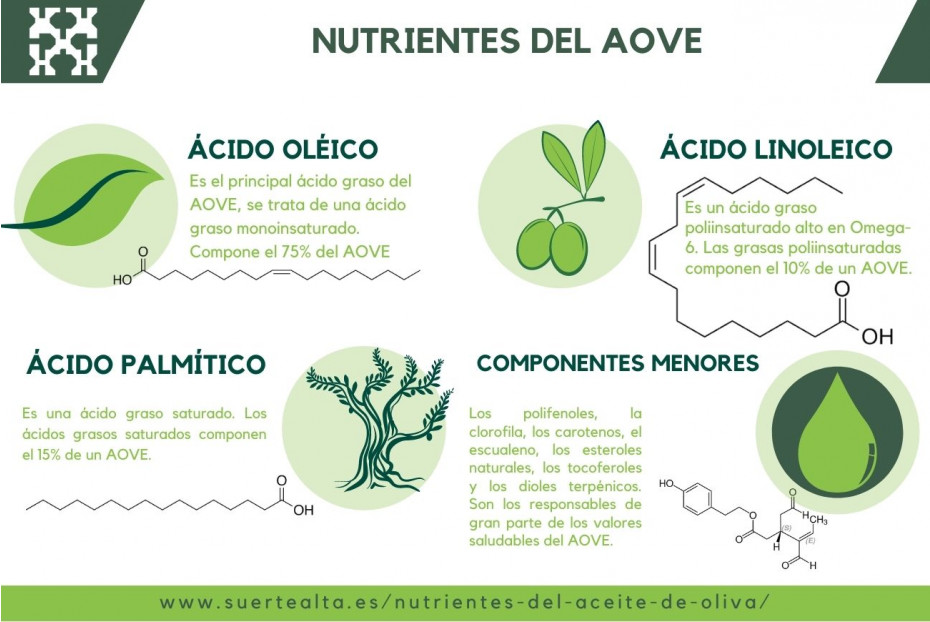
The main nutrients in Extra Virgin Olive Oil are fatty acids. The most important of these is oleic acid, a monounsaturated fatty acid.
Every 100 grams of EVOO contains 75 g of monounsaturated fat (oleic acid), 15 g of saturated fat (mainly palmitic acid) and 10 g of polyunsaturated fat (mainly linoleic acid). To a lesser extent, it also contains polyphenols, chlorophyll, carotenes, squalene, natural sterols, tocopherols and terpenic diols: the so-called “unsaponifiable fraction”.
What nutrients are in supermarket “olive oil”?
A bottle labelled simply as “olive oil” is actually a blend of refined oil (90–95%) with a small amount of virgin or extra virgin oil (5–10%). Refined oil loses most of its unsaponifiable fraction during the chemical process, which is why it has no flavour: it has lost its polyphenols. What it does retain is its fatty acid composition, which is high in oleic acid.
Olive Oil vs. Sunflower Oil
Olive oil contains more oleic acid (56–83%) than sunflower oil (15–38%), while sunflower oil contains more polyunsaturated linoleic acid (50–72%, compared with 3.5–21% in olive oil).
The Nutrients in Cortijo de Suerte Alta’s EVOOs
Polyphenol levels depend on the harvest, the variety, the soil, the climate and the extraction process. At Suerte Alta, the dry climate (which promotes water stress), early harvesting (October to November) and cold extraction result in EVOOs that are very high in polyphenols. Within our range, Picual contains more polyphenols than Arbequina, which is why Picual en Envero is more intense than Marqués de Prado, a blend that is 80% Arbequina. Polyphenols are responsible for bitterness and pungency: an oil that is neither bitter nor peppery probably contains few antioxidants, or may not even be an EVOO.
Frequently asked questions about the nutrients in EVOO
Oleic acid, a monounsaturated fat that makes up 75% of its composition.
Because of its polyphenol content: the higher it is, the more intense the bitterness and pungency.
Because the Picual variety accumulates more polyphenols than Arbequina, which makes up 80% of Marqués de Prado.
It loses most of its unsaponifiable fraction (polyphenols, vitamin E) during the chemical refining process, although it retains its fatty acid profile.