
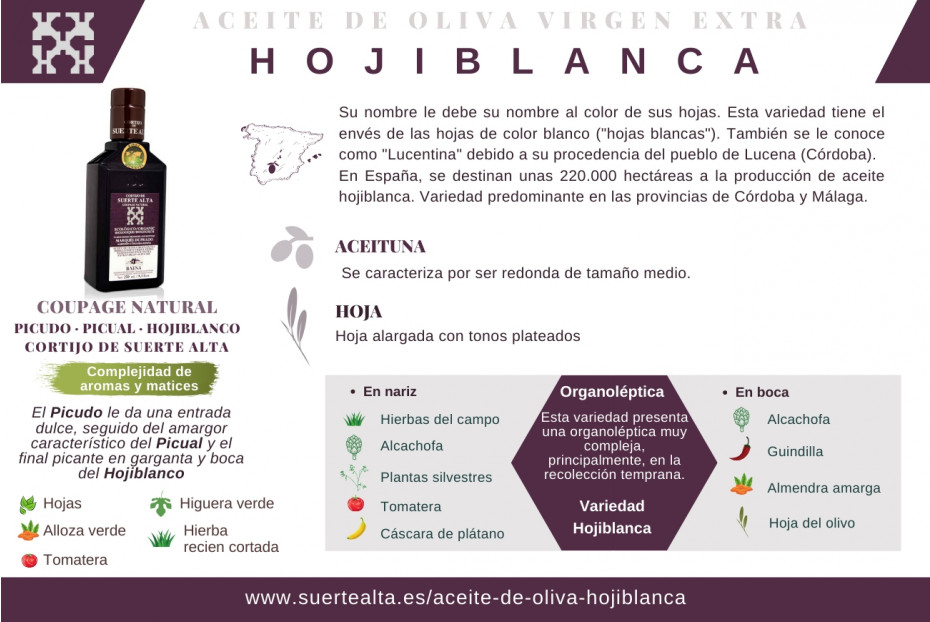
Hojiblanca oil owes its name to the colour of its leaves: their pale underside (“white leaves”, or “hojas blancas” in Spanish). It is also known as “Lucentina”, as it originates from Lucena (Córdoba). It is the predominant variety in Córdoba and Málaga, with some 220,000 hectares dedicated to its production in Spain.
KEY FACT
Spain devotes some 220,000 hectares to the production of Hojiblanca oil, the predominant variety in Córdoba and Málaga.
Organoleptic profile
Early-harvest Hojiblanca EVOO is very herbaceous, with aromas of artichoke, wild plants, tomato plant and banana peel. On the palate you can taste the astringency of artichoke, a chilli-like pungency that rises from the throat to the palate, and the bitterness of bitter almond and olive leaf.
Blended with other varieties, it gains complexity: a coupage of Hojiblanca with Pajarero brings green banana peel, green apple and wild herbs on the nose, with a sweet entry and a milder pungency on the palate. With Picudo, green apple and pear stand out, with a more intense pungency in the throat.
The Hojiblanca in Suerte Alta’s Coupage Natural
The Baena PDO is characterised by centuries-old olive trees with the Hojiblanca, Picudo, Picual and Pajarero varieties interplanted. Olive growers planted them this way to stabilise production in the face of an extreme climate (if one variety failed one year, another made up for it) and to take advantage of cross-pollination.
Our Coupage Natural is the oil from our oldest olive grove with these four varieties, not a blend made at the mill: it is the product of the interplanted grove itself and a joint early harvest. It offers a sweet entry from the Picudo, the characteristic bitterness of the Picual and the final pungency in the throat and mouth from the Hojiblanca, which has earned us consecutive medals in the Baena PDO quality awards.
Frequently asked questions about Hojiblanca oil
From the pale colour of the underside of its leaves.
In the provinces of Córdoba and Málaga, across some 220,000 hectares in Spain.
Its characteristic pungency in the throat and mouth.
With Pajarero, notes of banana peel and wild herbs; with Picudo, green apple and pear with a more intense pungency.