

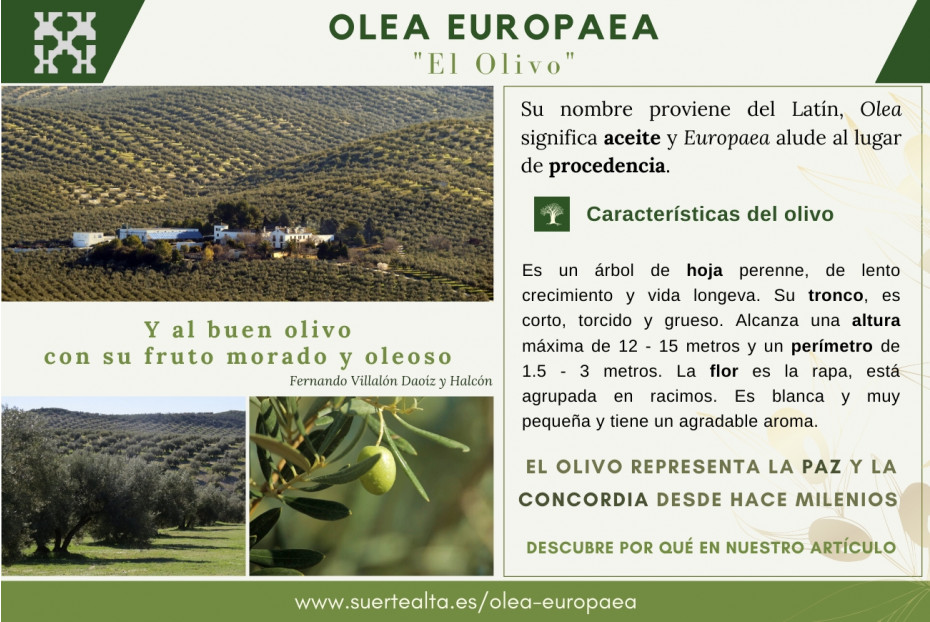
Olea europaea is a slow-growing, long-lived evergreen tree with a short, twisted, thick trunk that reaches between 12 and 15 metres in height depending on the variety.
KEY FACT
Today the olive tree appears on the flag of the United Nations as a universal symbol of peace.
Etymologically, “olea” means oil and “europaea” refers to its place of origin. Its flower, known in Spanish as “rapa”, grows in small white clusters with a pleasant scent and blooms between April and May.
A millennia-old symbol
The olive tree has represented peace and harmony for millennia. In Greece it was sacred to Apollo and was planted in front of temples. In Rome, Numa Pompilius (second king of Rome, 716-674 BC) is depicted holding an olive branch, a symbol of his peaceful reign. In the Bible, the dove brings back an olive branch after the Great Flood. Today, the olive tree appears on the flag of the United Nations.
Frequently asked questions about Olea Europaea
“Olea” means oil in Latin, and “europaea” refers to its European origin.
Because of its presence in Greek mythology (sacred to Apollo), Roman iconography and biblical texts, right up to the UN flag.
Between 12 and 15 metres tall, depending on the variety.
To Apollo, and it was planted in front of temples.

