Xylella fastidiosa is a bacterium with significant potential for economic damage. At the end of 2017, the European Commission again issued a warning about this microorganism, responsible for the death of hundreds of thousands of trees in Europe and more than one million olive trees in Italy.
KEY FACT
Xylella fastidiosa has already infected and killed more than one million olive trees in Italy, and there is still no known antidote.
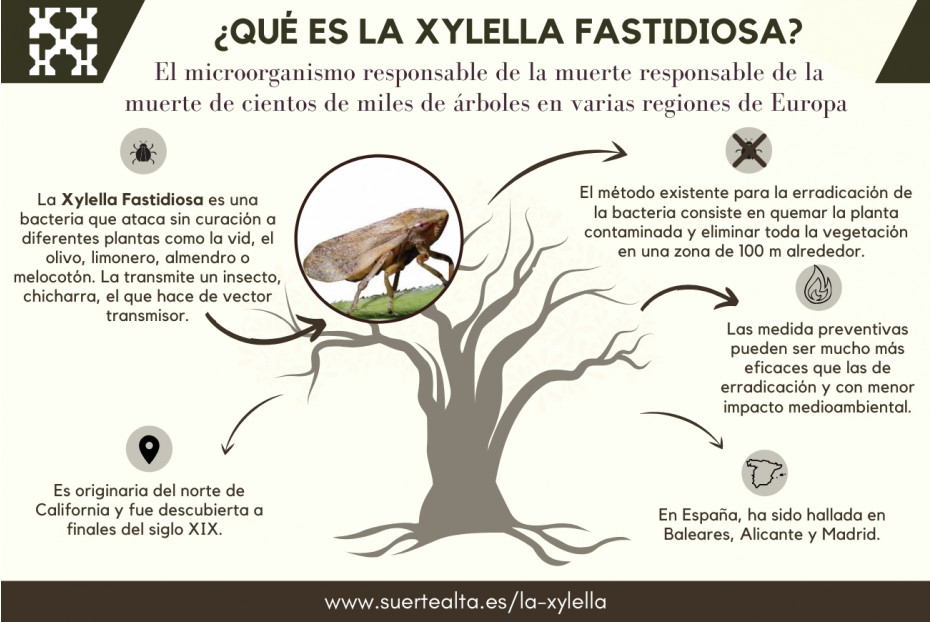
With no known cure, it attacks economically valuable plants such as grapevines, olive trees, lemon trees, almond trees, and peach trees. Native to northern California, it was discovered in the late 19th century; to date, there is no antidote.
How Xylella is combated
In France and Italy, contaminated plants are burned and the affected area is sealed off. The bacterium spreads through the bites of sap-sucking insects, so prevention is more effective than eradication once it has become established.
The situation in Spain
Although it has not yet affected the large olive groves in the south, Xylella has been found in the Balearic Islands, Alicante, and Madrid. The Spanish Olive Oil Interprofessional Organisation has signed an agreement with seven research bodies for its eradication, containment, and control, with the aim of preventing it from reaching Andalusia’s large olive groves, which would entail losses of millions.
Frequently asked questions about Xylella
A bacterium with no known cure that attacks plants such as olive trees, grapevines, and almond trees.
No, for the time being it has only been detected in the Balearic Islands, Alicante, and Madrid.
Through the bites of sap-sucking insects.
An agreement between the Spanish Olive Oil Interprofessional Organisation and seven research bodies for its eradication, containment, and control.