This experiment explains why different olive oils freeze at different temperatures.
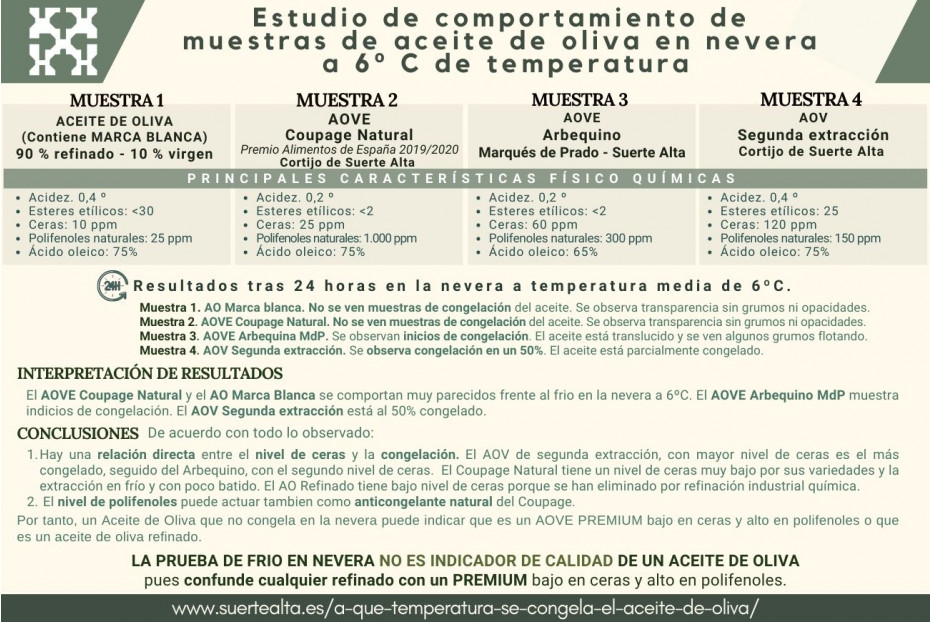
Given public interest in how different oils react to cold, we analyzed the behavior of several olive oil samples from the 2019/2020 harvest season in a refrigerator, at 6°C.
The samples analyzed
- Olive oil, contains… (white label, 90% refined and 10% virgin blend)
- Suerte Alta Coupage Natural EVOO
- Suerte Alta Marqués de Prado Arbequino EVOO
- Suerte Alta Second Extraction VO
KEY FACT
After 24 hours in the refrigerator at 6°C, the Coupage Natural EVOO and the white label oil (refined) behaved very similarly: showing no signs of freezing. The Arbequino Marqués de Prado showed initial signs of freezing, and the second extraction oil froze to 50%.
Why doesn’t Coupage Natural freeze like other EVOOs?
Coupage Natural differs mainly in acidity (0.2º vs. 0.4º for refined) and, above all, in polyphenols (1,000 ppm vs. 25 ppm). The wax level also influences this: the more waxes an oil has, the sooner it freezes. Coupage Natural, due to its cold processing and low malaxation, has a very low wax level.
How the harvest time affects it
A Picual EVOO harvested in early November and cold-processed at 25°C (like Suerte Alta’s) has a very different analysis from the same olive harvested in January and processed at 30°C: the former would be a premium EVOO (25 ppm waxes, 1,000 ppm polyphenols) and the latter, a mid-range EVOO (50 ppm waxes, 300 ppm polyphenols). In a cold test, the mid-range one will freeze sooner.
Frequently asked questions about olive oil freezing
Not necessarily. The cold test does not determine the quality of an oil. A premium EVOO low in waxes and high in polyphenols can behave the same as a refined oil.
It mainly depends on its wax level: the higher the wax level, the sooner the oil freezes.
Oleic acid at 5.5°C, palmitic acid at 18°C, and linoleic acid at -2.8°C. The temperature of a refrigerator (6°C) coincides precisely with the freezing point of oleic acid, which is the most abundant in EVOO.