

The olive tree has a short, twisted, thick trunk and a very wide, branching crown, reaching up to 10 meters in height. Its flower, known as the “rapa”, is white and very small, and grows in clusters.
KEY FACT
The oldest olive tree on the peninsula, in Ulldecona (Tarragona), is estimated to be 1,702 years old.
It is a tree of remarkable longevity, capable of living for thousands of years. The oldest olive tree on the peninsula is located in Ulldecona (Tarragona), with an estimated age of 1,702 years. It is a native species, perfectly adapted to the Mediterranean climate, and its plantations in Andalusia contribute to a sustainable ecosystem.
Resistance and sensitivity of the olive tree
The olive tree is sensitive to frost: it cannot withstand temperatures below -10°C. It tolerates heat well, although high temperatures can be harmful during flowering.
The olive tree in culture
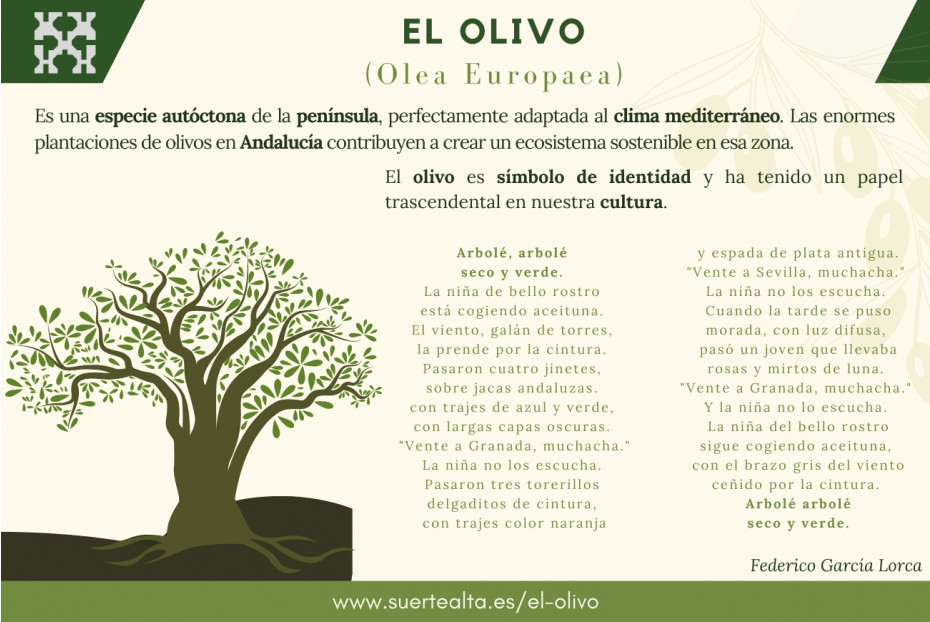
It is a symbol of identity and has played a pivotal cultural role. In his poem Arbolé, arbolé, Lorca describes the olive tree as “dry on the outside” (because of the appearance of its sturdy trunk) but “green and alive on the inside”: “Arbolé, arbolé / seco y verde”.
Frequently asked questions about the olive tree
Thousands of years. The oldest on the peninsula, in Ulldecona, is around 1,702 years old.
It does not tolerate temperatures below -10°C well.
It is a symbol of identity, present in literature, as in Lorca’s poem Arbolé, arbolé, and in Mediterranean tradition.
It does not tolerate temperatures below -10°C well.

