

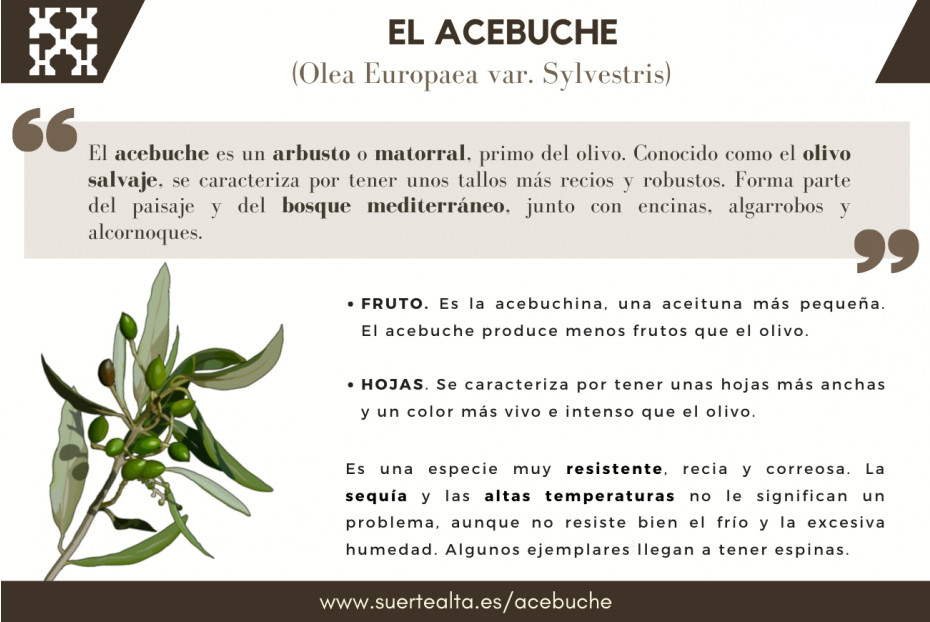
The wild olive tree is a shrub or bush, a relative of the cultivated olive tree. Known as the “wild olive tree,” it is characterized by hardier stems, wider leaves, and a more vibrant and intense color than the cultivated olive tree.
KEY FACT
The wild olive tree is the same species as the cultivated olive tree (Olea europaea var. sylvestris). If an olive tree is left to grow wild, it eventually resembles a wild olive tree.
Its scientific name is Olea europaea var. sylvestris. In fact, if an olive tree is left to grow wild, it eventually adopts the characteristics of a wild olive tree.
The fruit of the wild olive tree
Its fruit, the acebuchina, is a smaller olive, and the wild olive tree produces fewer fruits than the cultivated olive tree. It is part of the Mediterranean forest alongside holm oaks, carob trees, and cork oaks. Although unusual, it can reach 10 meters in height, though it typically grows as a shrub or bush. It is resistant to drought and heat but does not tolerate cold or excessive humidity well. Some specimens even develop thorns.
Frequently Asked Questions about the Wild Olive Tree
The wild relative of the olive tree, known as the “wild olive tree.”
Acebuchina, a smaller olive than that of the cultivated olive tree.
No, unlike drought and heat, which it tolerates well.
With holm oaks, carob trees, and cork oaks.

